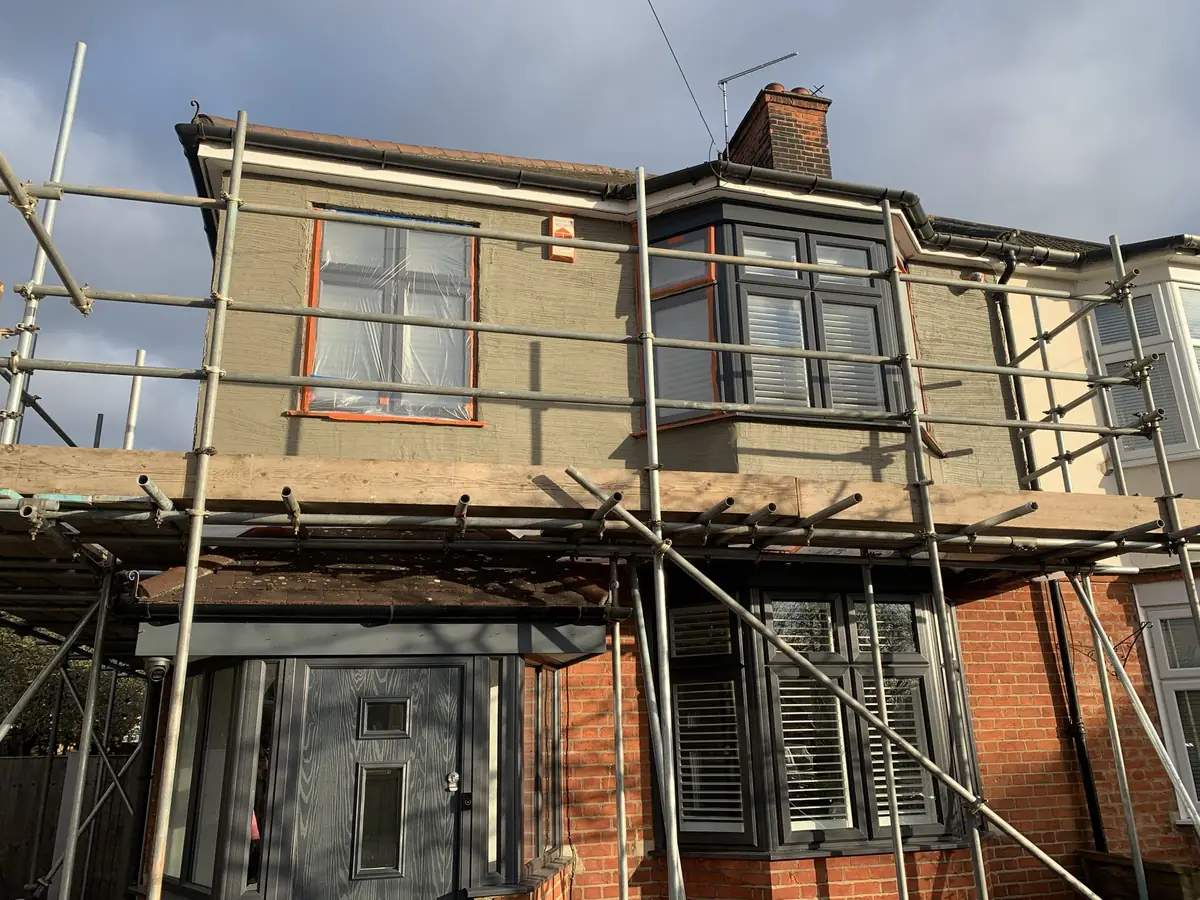
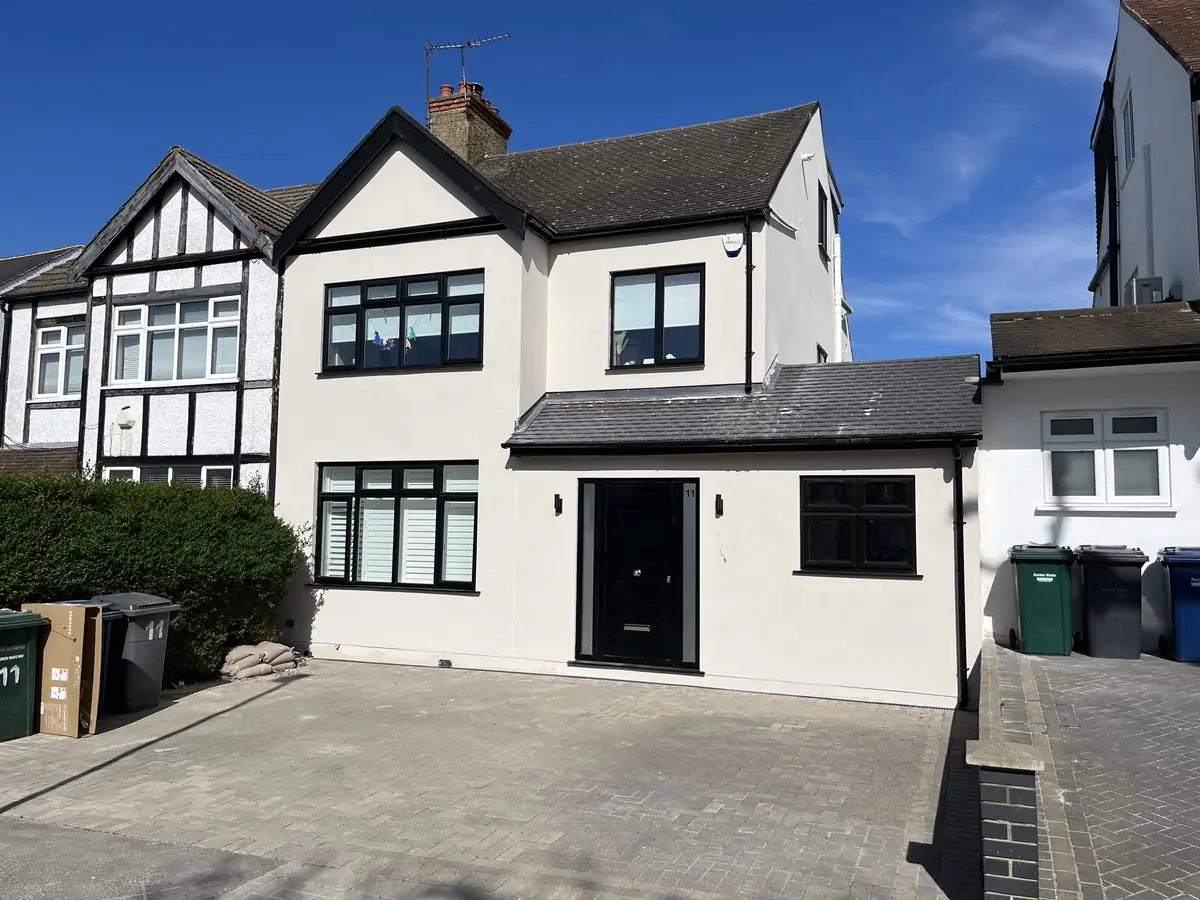
Edgware grew up around the Northern line extension of 1924, and the suburb that followed is dominated by interwar semis and terraces. Those houses are now approaching a hundred years old, and the original render on many of them is well past the end of its service life.
If your neighbours have started having scaffolding up, that is not a coincidence. Edgware was built quickly and to a pattern. Houses on the same road often share an age, a wall construction and an original render specification, so they reach the point of failure within a few years of each other. It is worth knowing this before you assume something unusual has gone wrong with your house specifically. In most cases nothing has. The finish has simply done its ninety years.
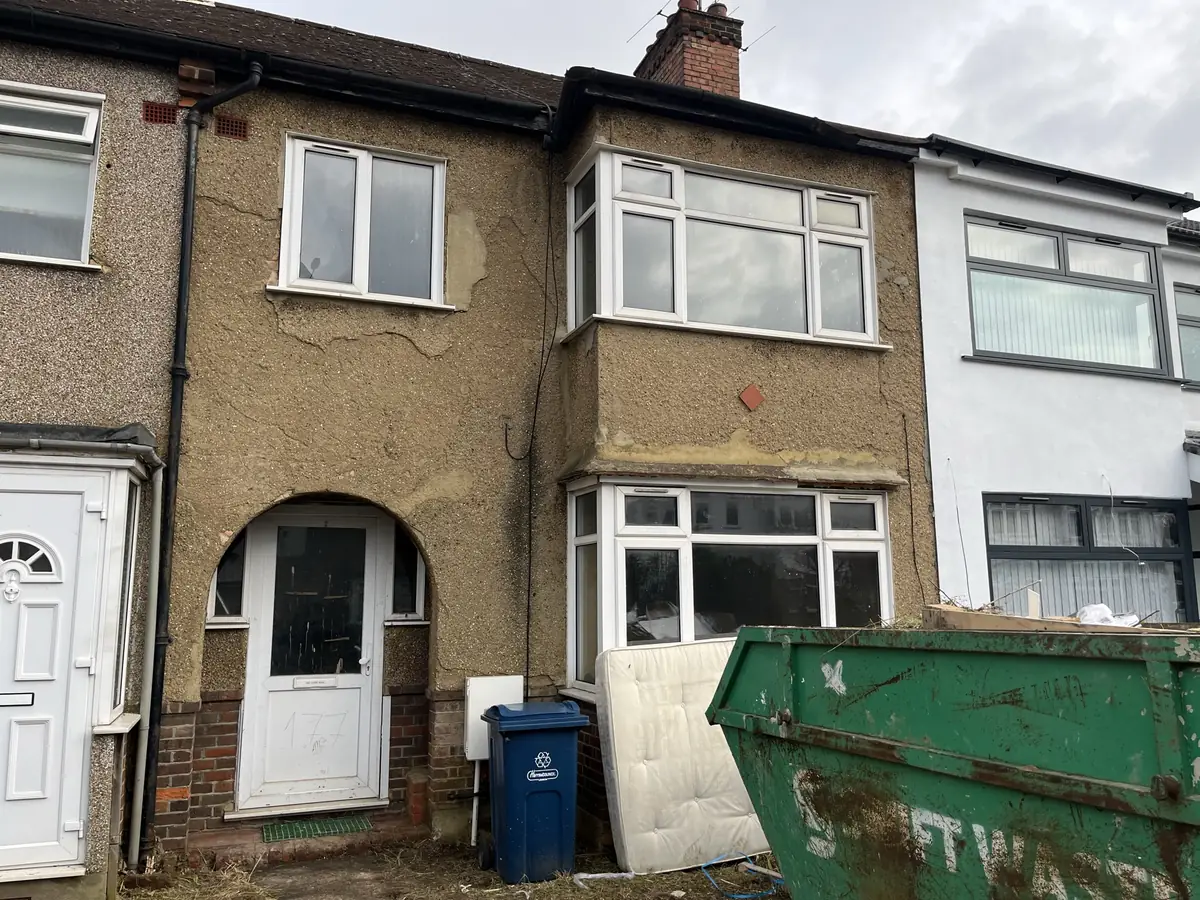
We survey the whole elevation before recommending anything, because the visible crack is often not where the problem started.
If the real fault is drainage rather than render, we say so. Repairing render over a live leak wastes your money.
Contained damage on a wall that is otherwise sound is a repair job, and we are happy to do it as one. The honest caveat is cosmetic: a patch on aged pebbledash or roughcast will rarely disappear, because the original aggregate and eighty years of weathering cannot be matched. Some homeowners accept that. Others would rather do a full elevation and be done with it.
Where the render has failed across most of a wall, or has been patched repeatedly, a full re-render is usually the more economical route once scaffolding is taken into account. And because most Edgware homes of this era are solid-wall, that is also the natural point to ask whether an insulated system makes sense while the wall is stripped and the access is already in place.
Whichever route you take, the detailing is what separates a job that lasts from one that fails again in five years. Beads at the corners and reveals, proper stop details at sills and eaves, and a finish chosen for the wall it is going onto rather than for whatever is quickest to apply.
Most of Edgware went up in the 1920s and 1930s, so a large number of homes share the same age, the same construction and often the same original render. Finishes of that era reach the end of their life at broadly the same time, which is why whole streets start showing cracking within a few years of each other.
Yes. We work across HA8 and the surrounding area, including Burnt Oak, Canons Park, Queensbury, Edgwarebury and out towards Mill Hill and Stanmore.
A contained repair can be a few days including scaffolding. A full elevation is longer, and render needs time to cure between coats, which the weather affects. Your surveyor gives you a realistic sequence rather than a best case.
Rarely, on an old finish. We will tell you at survey how visible we expect a repair to be, so the decision is yours and not a surprise at the end.
We work on solid-wall and period homes across North and North West London, including:
One short form, or a WhatsApp message with a few photos and your postcode. A real surveyor takes it from there.